
Beyond Listening: Putting Students at the Center of Change
DC State Board of Education: Student Advisory Committee
Alexander Ting, Student Representative
Andrew Roof, SBOE Public Information Officer
A note from the Collaborative
At the DC Postsecondary Success Collaborative, we believe improving postsecondary outcomes starts with listening to young people. Student voice is most powerful when it goes beyond asking for feedback and gives students meaningful opportunities to shape the questions we ask, the information we gather, and the solutions we pursue.
That’s what makes the Youth Participatory Action Research (YPAR) approach highlighted in Alexander Ting’s reflection so compelling. Rather than positioning students as subjects of research, YPAR positions them as researchers and decision-makers, with adult partners providing the tools and support to turn their lived experiences into actionable recommendations. For practitioners working to strengthen postsecondary success, this distinction matters: our advising practices, resources, and policies are stronger when young people help shape them.
The Collaborative is excited to build on this approach through our Youth Ambassador Council, launching in 2027. This Council will create a dedicated space for DC learners to help ensure our work remains grounded in young people’s experiences and aspirations, while also supporting them to be postsecondary success leaders in their communities. We’re pleased to share Alexander’s perspective on what it looks like when student voice is not simply invited, but put into action. Thank you to the DC State Board of Education, the DC Education Research Collaborative, and Alexander for this incredible work.
Alexander Ting is a guest writer and a senior at BASIS DC. He has been on the State Board of Education’s Student Advisory Committee for two years and was recently appointed a student representative for the 2026–27 school year.
SBOE Student Advisory Committee and DC Education Research Collaborative Work Together to Yield Insights Into Issues of Top Concerns to Students
The DC State Board of Education is the District of Columbia’s only body elected directly by constituents to represent their interests as they relate to education. An independent agency, the State Board is made up of nine elected representatives, one representing each of the district's wards, and one representing DC at large. There are also four appointed student representatives who chair the Board’s Student Advisory Committee.
The DC State Board of Education created a Student Advisory Committee in 2015 to ensure representation of diverse student perspectives in policymaking. Last school year, 2025–26, the group reached its largest membership ever, with 147 high school sophomore, junior, and senior members. Meeting monthly from September 2025 to June 2026, the Student Advisory Committee contributed to the State Board’s work, providing feedback on proposed resolutions and policy implementation, such as the recent ban on cellphones.
Creating this vigorous space where student voice is elevated has significantly improved the Board’s deliberations and decision making. It has encouraged elected members to be more contemplative, more curious. And it has pushed the Board to bring forth proposals that are not just well-intended but also rooted in students’ lived experiences.
Today’s guest author, Alexander Ting, senior at BASIS DC, is an appointed student representative for 2026-27 school year. Last year, he was an integral participant in the Student Advisory Committee’s Youth Participatory Action Research (YPAR) project, which was presented to the Board earlier this summer.
A New Approach to Student Research
In the 2025–26 school year, the Student Advisory Committee partnered with the DC Education Research Collaborative (DCERC), a research-practice partnership including the Urban Institute and research assistants from Georgetown University and the University of the District of Columbia, to explore three pressing subject areas for students: college and career readiness, school safety, and mental health resources. To support the Student Advisory Committee’s exploratory research, the DCERC coached our membership in using the YPAR framework (see their research brief here).
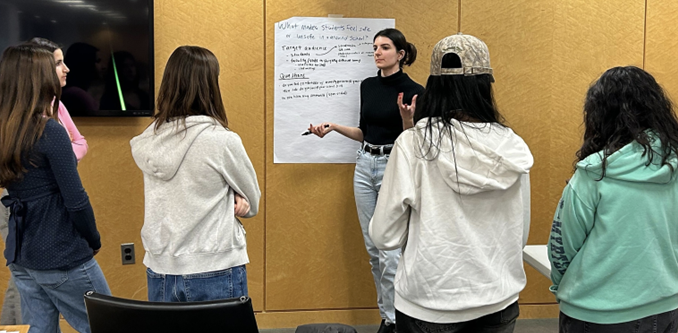
(Left) Members of the School Safety research group discussing what makes students feel safe.
The YPAR framework endorsed peer-to-peer research, supported by independent experts. Instead of providing students with structured assignments and deadlines like in a class, the framework positioned the Collaborative’s researchers as assistants and empowered students as the decision-makers. Student Advisory Committee members were in charge of forming research questions, deciding how to collect data, and finalizing recommended solutions.
I participated in the group which explored mental health resources. Our first step in the research process entailed sharing our own lived experiences. We spoke about lingering stigmas regarding mental health, feeling obligated to prioritize our academics, and having inconsistent support systems. The DCERC then guided us in converting these experiences into effective research questions, such as:
What mental health resources are currently available to students?
What barriers exist (real or perceived) between students and available resources?
What experiences do students have with mental health support?
We approached these questions first through an inventory audit of resources posted online. We found that many were outdated or by referral only. Then, over several months, we designed a survey for students in public high schools across DC and distributed it through student-led methods such as social media and school flyers. Our questions probed students’ experiences in accessing available resources, challenges faced, and how systems can better support students. The DCERC also met with us virtually to teach us how to professionally contact and interview students. These methods helped the mental health group surface several valuable insights.
Notably, we learned that less than half of over 200 respondents felt that their mental health was well-supported at school. Furthermore, we learned that sentiment decreased from freshman (61% felt well-supported) to senior year (35%).
In April and May, we worked with the DCERC to synthesize, graph, and analyze this data into a final report to present to the State Board of Education.
Being involved in this months-long, focused research group was deeply rewarding. One of the Student Advisory Committee’s most discussed issues is mental health, its impact on students, and how quantifying and mitigating it remains a challenge. While that continues to be the case, the YPAR framework enabled the Student Advisory Committee to render four actionable recommendations to the State Board.
Research Results
At the working session on June 3, our student representatives presented the Student Advisory Committee’s final recommendations to the State Board of Education. The full recommendations can be found in the Student Advisory Committee’s annual report (pp. 17–22).
The college and career readiness group recommended making college counselor meetings and college/career fairs more frequent, increasing access to rigorous programs such as dual enrollment and AP classes, and providing teachers with professional development on the college application process.
The mental health resources group recommended reducing stigma through lessons on mandated reporting, clarifying what resources students have access to, accounting for grade differences in mental health struggles, and taking a continually preventive, rather than sporadic, approach to mental health issues.
The school safety group recommended revisiting the ban on cellphones, extending student safety measures to teachers, more rigorously screening staff, and increasing transparency about safety policies and incidents.
After these recommendations were made, summer student fellows for the State Board, provided through Mikva Challenge DC, a youth civic organization, met with DC Councilmembers to learn how advocacy can further the above recommendations to become reality.
How to Replicate This
Integrating student voices into different layers of policy, from research to implementation, is crucial for effective and representative education measures. The YPAR framework offers a mode through which to do that. From my experience with YPAR, here are best practices I’ve learned to maximize its enrichment for students and value to policymakers:
Build an informal space. Student Advisory Committee members felt more comfortable with fewer formalities. They were able to choose their research topic, split into smaller groups, bounce ideas back and forth, and treat the research process as service rather than classwork.
Be available to step in. Students may be unable to attend meetings, so collaborators regularly following up with next steps helps catch them up. Additionally, students may find tasks time-consuming or overwhelming, which is where organizations can fill the gap. For example, while Student Advisory Committee members designed the survey questions, the DCERC digitized them and created flyers to share with others.
Accept that obstacles can occur. Some tasks may be difficult to complete even with a talented student group. For example, the mental health resources group faced challenges in representing diversity in its report, as it received limited survey responses from some wards. Rather than getting caught up in specific issues, it’s better to maintain momentum and keep students focused on what’s next.
How SBOE and the SAC will use research recommendations in the future.
As mentioned previously, summer student fellows for the State Board presented findings from the Student Advisory Committee’s research to elected members of the DC Council throughout July. Those discussions gave encouragement and food for thought on how students’ recommendations can be pushed further in the future. Councilmembers expressed interest in getting deeper insight into some of the fields touched on by the 2025-26 research project, particularly disparities in college and career readiness access. Several councilmembers also extended invitations in these conversations for the Student Advisory Committee to have representation on upcoming roundtables and advisory bodies to be hosted by DC Council. The State Board and Student Advisory Committee are excited to explore such issues more deeply in the upcoming school year and strengthen advocacy for proposals to improve the education experience for students city-wide.